The question of when and where golf was introduced to America has challenged historians for decades. I don’t claim to have the definitive answer, but I can present a collection of documented references to the game in its earliest American forms.
Before beginning our search for the origin of golf in America, it’s helpful to understand something of when and where the game itself truly began. Many will immediately name Scotland as the Home of Golf. My good friend and world-renowned golf historian, Dr. Tony Parker, would likely argue that the game as we know and play it today did indeed take shape in Scotland.
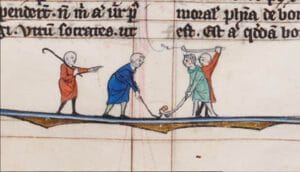
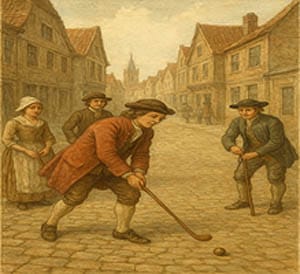
With the resources available to me, I’ll share what I’ve learned about the origin of golf – at least the early history of golf. The image to the left, often cited in this discussion, illustrates that a golf-like game has existed for hundreds of years.
A golf purist might argue they are playing an early form of hockey, as the man and woman appear to be fighting for the ball. Still, I propose another theory about the evolution of golf.
My research on the origin of golf led me to the Netherlands, where a game called Kolven or Kolf was played and documented in the 14th and 15th centuries. It appears to have been played both on ice and on dry land.
Golf migrates southward in Europe
In the northern regions of Europe, where snow and ice dominate the landscape for much of the year, a game similar to modern-day ice hockey may have been played and known as Kolven. When spring and summer arrived, and the ice melted, players likely continued their game on dry land, adapting the rules to the new terrain. Perhaps the dry-land version came to be known as Kolf.
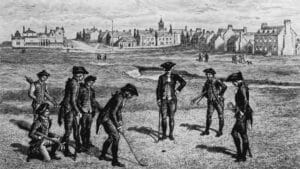
As the game migrated southward over the centuries into milder climates, it seems to have taken on more of the qualities of modern-day golf. If this is so, it may be at this stage that ice-golf and land-golf required differentiation, and each evolved with new names and more formal structures. Warmer seasons would naturally have favored the land-based version.
Assuming golf’s arrival in Scotland coincided with this differentiation, it’s likely the Scots added rules and structure and altered the name from Kolf to Golf. Scotland was certainly responsible for shaping the game into the form we recognize today.
A changing golf demographic
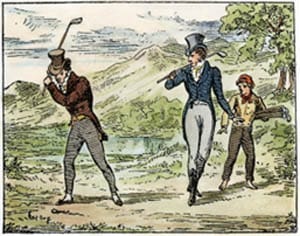
Golf, as it developed in both Europe and America, became a social pastime: a reason to gather and celebrate. It was played among small groups where friendship and conversation mattered as much as the game itself. Except for occasional competitions among better players, golf was about enjoyment and recounting the day’s round over a pint of ale.
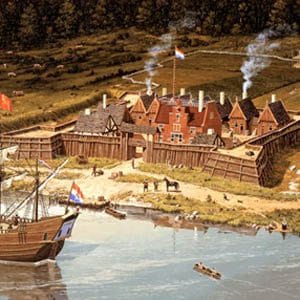
History tells us that in the 16th century, Europeans began migrating to America, bringing with them their culture, which likely included some form of golf. One potential source of early American golf dates to 1624, when several Dutch families left their homes in the southern Netherlands (now part of Belgium) and settled at Fort Orange, near present-day Albany, New York.
Golf’s arrival in North America
The earliest documented evidence of the origin of golf in America appears on July 22, 1657, in the official minutes of the Fort Orange Court, where men were cited for playing Kolven on the Lord’s Day. Two years later, in 1659, the same court passed an ordinance forbidding the play of Kolf in the streets because it broke windows and endangered property. The two different spellings within such a short time are noteworthy.
It is striking that the earliest references to golf in America occur in prohibitions. This mirrors Scotland’s early history, where in 1457 the Scottish Parliament banned golf because it interfered with archery practice. History suggests that both countries initially viewed golf as a nuisance.
Evidence suggests that early golf in America originated in the northeastern United States, where it appears to have been played by ordinary people when time permitted. As the game moved southward, it became increasingly associated with the leisure class and served as a marker of social status.
By the 1800s, golf had reached the Deep South and was established in cities such as Charleston, Savannah, and New Orleans. The Savannah Golf Club preserves an invitation dated December 20, 1811, announcing a Ball hosted by the golf club of that city. At that time, golf was largely the pastime of the wealthy and successful.
Sadly, the War of 1812 and the Civil War heavily affected southern cities, and evidence of golf there becomes scarce through the mid-1800s. After the Civil War, and by 1890, golf flourished in America and was adopted by both the rich and the middle class. Golf had transitioned from a game played on town streets to manicured golf lawns that copied the best of European courses.
Moving back to our original question of, where did it all start? As expected, I cannot provide an answer for who hit the first golf ball in America. However, if we accept that Kolven, Kolf, and Golf all share a common ancestry, the strongest evidence suggests that the first strike occurred at Fort Orange, New York, at the hands of early Dutch settlers.
While I’m certain a good argument could probably be made for other groups or locations owning the first golf shot, I’ve given this topic my best research and provided you with my theory and conclusion. Until more evidence to the contrary surfaces, I’m satisfied to believe America’s first golf was played at Fort Orange.
Larry Hall is a golf historian and golf writer who runs the website budgetgolftripstips.com
Have a story idea or a news item to report to Alabama Golf News? Email gregg@alabamagolfnews.com
Featured image created and edited with the aid of artificial intelligence